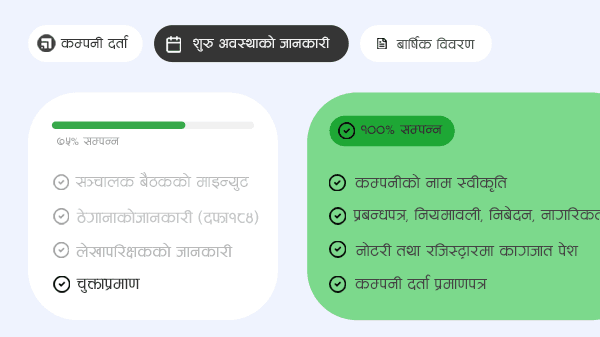
Every company must comply with its Articles and Memorandum of Association (AOA & MOA) and other regulatory provisions. While registration is simplified with consultancy services, post-registration obligations remain. Prabandha offers assistance with these obligations with its compliance package and accounting package. Key post-registration requirements include submission of documents to OCR like Details of Address, Appointment of Auditor etc., tax compliance, accounting records maintenance, licensing, and staying informed about regulatory changes.
Prepare Company Seal
A company, being a legal entity, lacks the ability to sign official documents independently, akin to a natural person. Therefore, it is mandated for every company to create a unique company seal clearly displaying its name. This seal must be utilized in all company-related documents, encompassing reports, records, and any commercial paperwork representing the company. You may require company seal in preparing the following documents so it is advisable to get your seal at the beginning.
Acquire a license or permit.
Some businesses and industries necessitate obtaining licenses or permissions from the respective governing departments or bodies overseeing those operations. If your business mandates additional licenses, permissions, or registrations for its operations, kindly ensure compliance with those requirements as well. In Some circumstances, the licensing authority may also ask for PAN, in this case it would be advisable to get PAN number first and then go for licensing
- Every construction firm is mandated to secure a Construction License from the local authority.
- Media enterprises need to acquire a license from the Department of Communications.
- Industrial companies are obligated to register with either the Department of Industries or the Cottage and Small-Scale Industries.
- Tour and travel agencies with specific objectives must obtain a license from the Department of Tourism.
- companies involved in food and feed products must be registered with the Department of Food Technology and Quality Control (DFTQC).
Registration with Tax authorities
OCR reserves a PAN number for your company; however, it's important to note that this is merely a reservation. You must log in to the income tax portal and access the registration section using the username and password provided by OCR in the letter. Complete the form, submit it online, print a copy, and proceed to the Inland Revenue Department (IRD) along with other required documents. Alternatively, you can also fill out a new form for PAN registration. When physically submitting the form to IRD, you'll need to include various documents such as the Memorandum of Association (MOA), Articles of Association (AOA), the application form stamped with the company seal, proof of address, and minutes of the board meeting authorizing registration and designating authority to one of the shareholders.
NOTE – while applying with the PAN reserved by the OCR, it may ask for the license number if your business is liable to be licensed and when you go for licensing, they may ask you your PAN number which is conflicting in itself. This happens due to non-coordination of different departments. You can simply apply for a new PAN number from the IRD. And go for licensing next
If your company engages in selling VAT (Value Added Tax) goods or items, it's necessary to register for VAT if the following transactions exceed:
- Goods turnover: Rs 50 lakhs
- Service turnover: Rs 20 lakhs
- Combined turnover of goods and services: Rs 20 lakhs
Question: Why do I need to register under the Inland Revenue Department (IRD) if I have already registered under the Office of The Company Registrar (OCR)?
Answer: Yes, you do need to register separately with the IRD even if you've registered with OCR. These two registrations serve different purposes. OCR is the central regulating authority for companies, ensuring legal compliance and proper governance. On the other hand, registration with IRD is specifically for tax purposes. Every business entity must register with IRD for PAN or VAT before commencing transactions to ensure compliance with tax regulations and fulfill their tax obligations. Therefore, both registrations are necessary to operate legally and fulfill different regulatory requirements.
Register at Ward Office / Department of Small and Cottage Industry
Registering a company at the ward office, as per the Business Act of the respective province, is typically a straightforward and quick process. It doesn't usually take much time and can be relatively easy to accomplish. However, depending on the nature of the business and its activities, additional registrations may be necessary. This could involve registering with departments such as the Department of Industries, Department of Small and Cottage Industries, or Department of Commerce. Some licensing authorities may require these registrations before issuing licenses for certain businesses. Therefore, it's important to be aware of these requirements and ensure compliance to facilitate smooth business operations.
Opening a bank account
Upon receiving your PAN certificate, it's imperative to promptly establish a bank account. A company bank account serves as the cornerstone for managing financial transactions effectively. It provides a centralized platform for receiving payments, making disbursements, and monitoring cash flow. By segregating personal and business finances, a dedicated account enhances financial transparency and simplifies accounting processes. Moreover, it fosters credibility and professionalism, as customers, suppliers, and investors prefer dealing with entities that maintain distinct financial accounts. Also to obtain share lagat, you need to provide a bank statement of your company showing the deposit of a sum equal to the allotted shares.
When selecting a suitable bank for your company, it's imperative to understand and fulfill the specific document requirements that each institution may have. Essential documents typically include board minutes, detailing the authorization to open a bank account, as well as a list of shareholders with signatory rights, and certified copies of the Memorandum and Articles of Association (MOA/AOA). These documents serve to verify the company's legal standing, governance structure, and the authority of individuals to operate the bank account. By carefully preparing and providing these documents, businesses can streamline the account opening process and establish a strong foundation for effective financial management. Additionally, considering factors such as the bank's reputation, services, and proximity to your business ensures that you choose a banking partner that aligns with your company's needs and values.
Submitting initial information to OCR
A company has to submit initial information to OCR which is commonly known as ‘तिन महिने बिवरण’. This includes reports such as Details of address, details of allotment, Minutes of Board meeting and AGM, details of Appointment of Auditor etc.
Details of Address -
According to Section 184(2), a company is required to set up a registered office and, within three months of its incorporation, officially register the address of this office at the Office of Company Registrar. Additionally, the company must provide contact details such as telephone number, fax, and email to the OCR. Any alterations to this information, including changes to the registered office address, must be promptly updated with the OCR. This registered office address serves as the designated location for receiving all official communications from various authorities.
Appointment of Auditor –
A company should conduct its meeting of Board of directors and appoint the Auditor for the financial Year. Details has to be submitted to OCR about such appointment within 15 days from such appointment.
Details of Allocation of shares –
Section 31 of the Company Act, 2063 stipulates that companies must furnish the Office of Company Registrar with the particulars regarding the allocation of shares within 30 days from the allocation date. These particulars encompass the quantity of shares allocated, the amount paid, the names and addresses of shareholders, and the individual payments made by each shareholder, as well as any outstanding balances, if applicable.
Lets not get too technical.
The shareholders shall deposit the call made by the company in the company's bank account and present the Bank Statement to the OCR as an evidence. Sometimes the Bank asks for ‘Share lagat’ Certified from OCR before opening the account in that case you can also present the cheque from respective shareholders bank account in the name of the company to the OCR.
After submission of the above documents you should apply for share lagat, which is the list of shareholders in the company. It includes the number of shares held by each shareholders. Once obtained, you need not obtain it every year. Only when shareholding change, you need to reapply for it. Share lagat is an important document. It shows that your shareholding is duly recorded in the OCRs books. And different authorities may also require it, e.g. - Banks require it before loan approval.
And yeah, you are all done for initial compliances. All this may sound very frustrating and believe us, it is 😉.
Prabandha
A complete solutions for your business needs
Are you prepared to streamline your company's post-incorporation process in Nepal? Reach out to Prabandha now for professional assistance and guidance in handling your compliance needs. Explore our entrepreneur-friendly client dashboard and get access to a transparent and simple compliance arrangement.
We are here to help you with your compliances. Join Prabandha and be our long term partner. We not only help you with compliances but once connected with us, we will provide you with regular updates, information on due dates, new laws and amendments etc.